
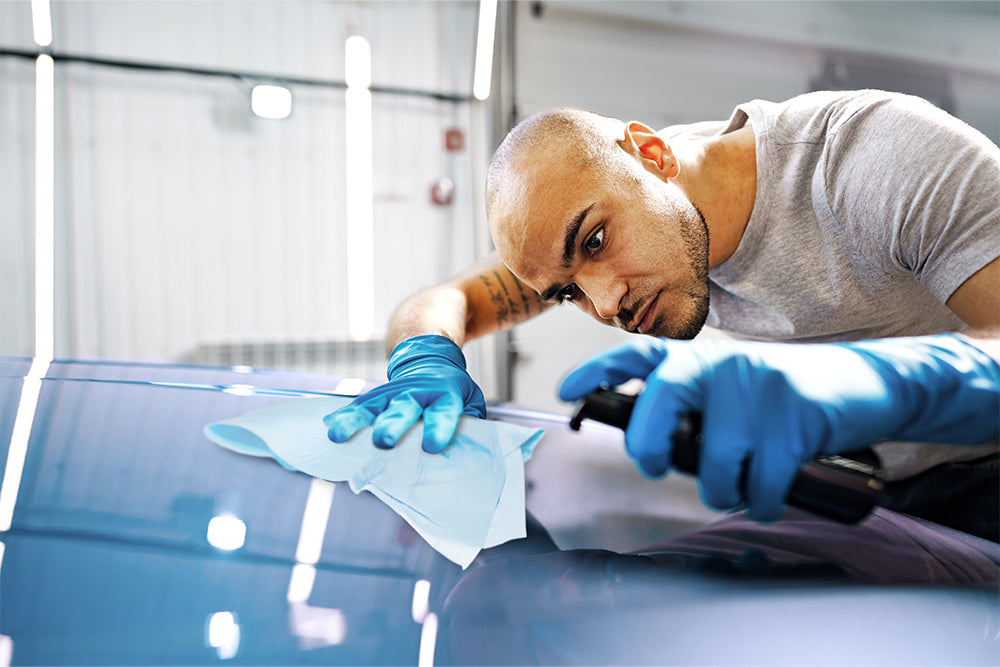
What is Lint? Minimizing Surface Contamination: Removing Lint
Lint is typically a very small or tiny fiber. The fibrous nature of lint makes it a stubborn contaminant to remove. In high-stakes industrial environments and professional workshops, manual decontamination requires specific methods. At the same time, your supplies (cloths and solvents) for removing lint should be carefully chosen so as not to add to the problem. In most workshops the following methods are used to remove lint and prevent lint from settling on a critical surface.
- Tack Cloth: Fully dry the affected surface, then utilize a specialized, chemically tacky cloth (Tack Cloth) to lift and lock away the loose particulate matter without leaving sticky residues behind (mainly used in metal and wood prep for painting).
- Mechanical Brushing: Allow the surface to dry completely, then use a clean, ultra-soft bristle brush to gently stroke the fibers away. To prevent micro-scratching on sensitive coatings or gel coats, always spot-test the brush stiffness in an inconspicuous or concealed area first.
- Solvent-Assisted Wiping: Ensure the substrate is dry, then execute a final wipe using a dedicated low-lint technical cloth, applying a task-specific solvent if your process permits. Spunlace nonwoven fabric remains the lowest-lint engineered wiper on the market and is uniquely optimized for this exact decontamination step. Other substrates are used and compared below with spunlace nonwoven fabric winning the prize for the lowest lint.
Solvent-Assisted Wiping: Deciding which wiper to deploy for your lint-free cleanup?
When your operation depends on eliminating microscopic lint, your choice of shop towel or wiping cloth is a critical quality-control variable. To assist in optimizing wiper supply choices, we have analyzed and ranked the industry's most popular wiping substrates based on their lint level.
In precision manufacturing, automotive refinishing, pharmaceutical manufacturing and controlled environments, surface contamination is a costly variable. What appears to be a minor speck of dust to an amateur is recognized by professionals as a catastrophic failure point. Lint-free wiping cloths are not a luxury; they are a baseline requirement for quality control and particle control.
To eliminate surface imperfections, facility managers and procurement specialists rely heavily on a specific class of high-performance nonwovens: spunlace low lint shop towels and wipers. Understanding how other fabrics compare is key to optimizing your shop's operations.
The Cost of Contamination: Why Low-Lint Wiping Cloth Performance is Critical
Standard industrial shop towels often shed microscopic particles when subjected to friction or chemical solvents. In high-stakes applications, this shedding leads to operational setbacks.
· Automotive Paint Prep & Refinishing
Before any primer, base coat, or clear coat hits a metal part, the surface must achieve absolute purity. Standard cotton rags or low-grade paper wipes release contamination or short cellulose fibers causing defects. The result is a series unnecessary defects and blemishes. Rectifying these errors requires extensive wet-sanding, compounding, and costly re-spraying, stalling production lines and increasing labor costs.
· Solid Surface & Countertop Fabrication
When fabricating acrylic, quartz, or solid surface countertops, clean seams are mandatory for structural integrity and aesthetics. Wiping down joints with high-shed materials deposits lint into the gap. This lint gets trapped in epoxy adhesives, weakening the molecular bond and creating visible, dark lines along what should be a seamless, pristine joint.
· Printing Press & Plate Cleaning
In precision offset and flexographic printing, lint represents an expensive operational bottleneck. When inferior wipes are used to clean ink fountains, blankets, or printing plates, paper dust transfers directly to the machinery. These fibers interfere with ink transfer, causing "hickeys"—small voids or white rings on the printed material. Resolving this requires a complete press shut-down for a mid-run wash, destroying throughput and increasing paper waste.
Pharmaceutical & Biotech Manufacturing
Controlled environments and cleanrooms operate under strict regulatory frameworks governing airborne and surface particulate matter. Standard wipes introduce loose fibers that compromise product batches and breach sterile protocols. Wiping down stainless-steel compounding vessels or packaging machinery demands chemically inert, ultra-low-shedding substrates that fulfill stringent parameters.
· Marine and Aerospace Maintenance
Maintaining hull surfaces, gel coats, aircraft aluminum, and composite structures requires high mechanical friction and aggressive solvents like MEK, acetone, or toluene. Inferior towels disintegrate rapidly under these conditions. Aerospace and marine technicians require structurally resilient wipers engineered for maximum durability and high wet/solvent strength in harsh environments.
Industrial Wiping Substrates: Lint Performance Comparison
|
Substrate/ Brand |
Core Materials |
Manufacturing Process |
Lint Level |
Wet/ Solvent Strength |
Best Application / Verdict |
|
Spunlace Fabric |
Polyester / Wood Pulp Blend |
Hydro-entanglement: High-pressure fluid jets mechanically interlock continuous long fibers. |
EXTREMELY LOW |
Excellent: Retains full structural integrity when saturated with aggressive solvents. |
The Gold Standard: Critical paint prep, printing press blankets, pharma cleanrooms, and glass. |
|
Hydroknit |
Wood Pulp / Spunbond Polypropylene |
Hydroentangled matrix fusing short wood pulp fibers into a continuous polypropylene web layer. |
LOW TO MED |
High: Highly absorbent and durable, though prone to minor pulp shedding on abrasive edges. |
Heavy-duty machinery wiping, grease removal, and general shop maintenance. |
|
Microfiber Towels |
Polyester / Polyamide Blend |
Woven synthetic fibers mechanically split to create a high-surface-area, wedge-shaped matrix. |
LOW (When Virgin) |
Moderate to Good: Durable synthetic chains, but can degrade under highly aggressive solvents. |
Final dry dusting, interior auto detailing, and wax buffing. High cross-contamination risk if reused. |
|
DRC Towels (Double Re-Creped) |
Wood Pulp / Latex Binders |
Cellulose fibers layered and bound together using chemical latex glues, then creped for bulk. |
MEDIUM |
Moderate: High initial absorption speed, but breaks down and sheds under heavy friction. |
Janitorial tasks, basic hand wiping, and soaking up heavy oil or grease spills. |
|
Airlay Nonwovens |
Short Wood Pulp Fibers |
Air-formed wood pulp web bonded utilizing synthetic thermal bonding resins or fibers. |
MED TO HIGH |
Poor to Moderate: Highly absorbent texture, but possesses very low mechanical abrasion resistance. |
Single-use janitorial wiping, surface drying, and low-friction wiping tasks. |
|
Cotton Rags (Laundered Shop Towels) |
Woven Cotton / Textile Scraps |
Traditional industrial weaving of short staple cotton fibers. |
HIGH |
High: Structurally rugged, but heavily releases loose threads, fibers, and structural lint. |
Crude mechanical work and raw grease cleaning where lint contamination is non-critical. |
FAQ: Understanding Lint and Wiper (Shop Towel) Engineering
Q. Why do traditional paper towels generate so much lint?
A. Traditional paper towels and commercial DRC wipers are manufactured from short, natural cellulose (wood pulp) fibers. To form a cohesive sheet, these fibers are bonded together using water-soluble chemical glues or latex resins. When these towels are exposed to moisture, water-based cleaners, or industrial solvents, those chemical bonds quickly dissolve or weaken. Under the mechanical friction of wiping, the short pulp fibers readily detach, leaving a heavy layer of visible lint residue on the surface.
Q. Why does spunlace hydroentangled fabric have significantly lower lint?
A. The exceptional performance of spunlace fabric is due to its mechanical construction. Instead of relying on brittle chemical glues to hold short fibers together, the spunlace process utilizes rows of high-pressure, water jets. These water jets strike a web of polyester and wood pulp fibers, forcing them to physically wrap and knot around one another. This hydroentanglement creates a highly secure, uniform, and continuous structure. Because the polyester fibers are mechanically locked and longer, they resist breaking or shedding, even when exposed to aggressive scrubbing or harsh chemical solvents.
Q. Where do microfiber towels fit into the lint generation hierarchy, and what are their limitations in industrial shops?
A. On a structural level, a brand-new, premium microfiber towel sits very low on the lint generation hierarchy because it is made of continuous synthetic filaments. However, microfiber is uniquely engineered to be mechanically "tacky"—its split-fiber structure acts like microscopic hooks that grab and hold onto dust, metal shavings, and dirt.
The primary limitation of microfiber in industrial settings is retained contamination. Because these towels are typically laundered and reused, the microscopic hooks permanently trap particulate matter that commercial washing cycles fail to remove. When reused in critical environments like automotive paint prep or electronic assembly, the towel acts as a carrier for cross-contamination, releasing previously trapped grit back onto the pristine surface. Microfiber's polyamide component is also susceptible to degradation when exposed to specific industrial solvents.


